- Financial Fluency
- Posts
- Can Bulls Live with Bears?

In partnership with

Become An AI Expert In Just 5 Minutes

If you’re a decision maker at your company, you need to be on the bleeding edge of, well, everything. But before you go signing up for seminars, conferences, lunch ‘n learns, and all that jazz, just know there’s a far better (and simpler) way: Subscribing to The Deep View.
This daily newsletter condenses everything you need to know about the latest and greatest AI developments into a 5-minute read. Squeeze it into your morning coffee break and before you know it, you’ll be an expert too.
Subscribe right here. It’s totally free, wildly informative, and trusted by 600,000+ readers at Google, Meta, Microsoft, and beyond.

Welcome to Financial Fluency - your monthly guide to mastering financial English, learning how money works, and making confident financial choices.
In this issue:
A Look at the Markets: Performance February 2026
Can Bulls Live with Bears?
Quote of the Day: Michael Saylor
We value your feedback
Word of the Day: Sentiment
Interactive Quiz
Whenever you are ready, here is how I can help you
A Look at the Markets: Performance February 2026
Note that the market closed for the month before the airstrikes in Iran. Any market volatility from this will be when the markets open on Monday 2nd March. This does not apply to Bitcoin with can be traded 24/7.
Vanguard FTSE All-World ETF (Accumulating)

JustETF
A nice 2.2% return (in Euros) for the Vanguard FTSE All-World ETF (Acc) for February. This is higher than the US dollar performance due to a slight weakening of the Euro against the dollar.
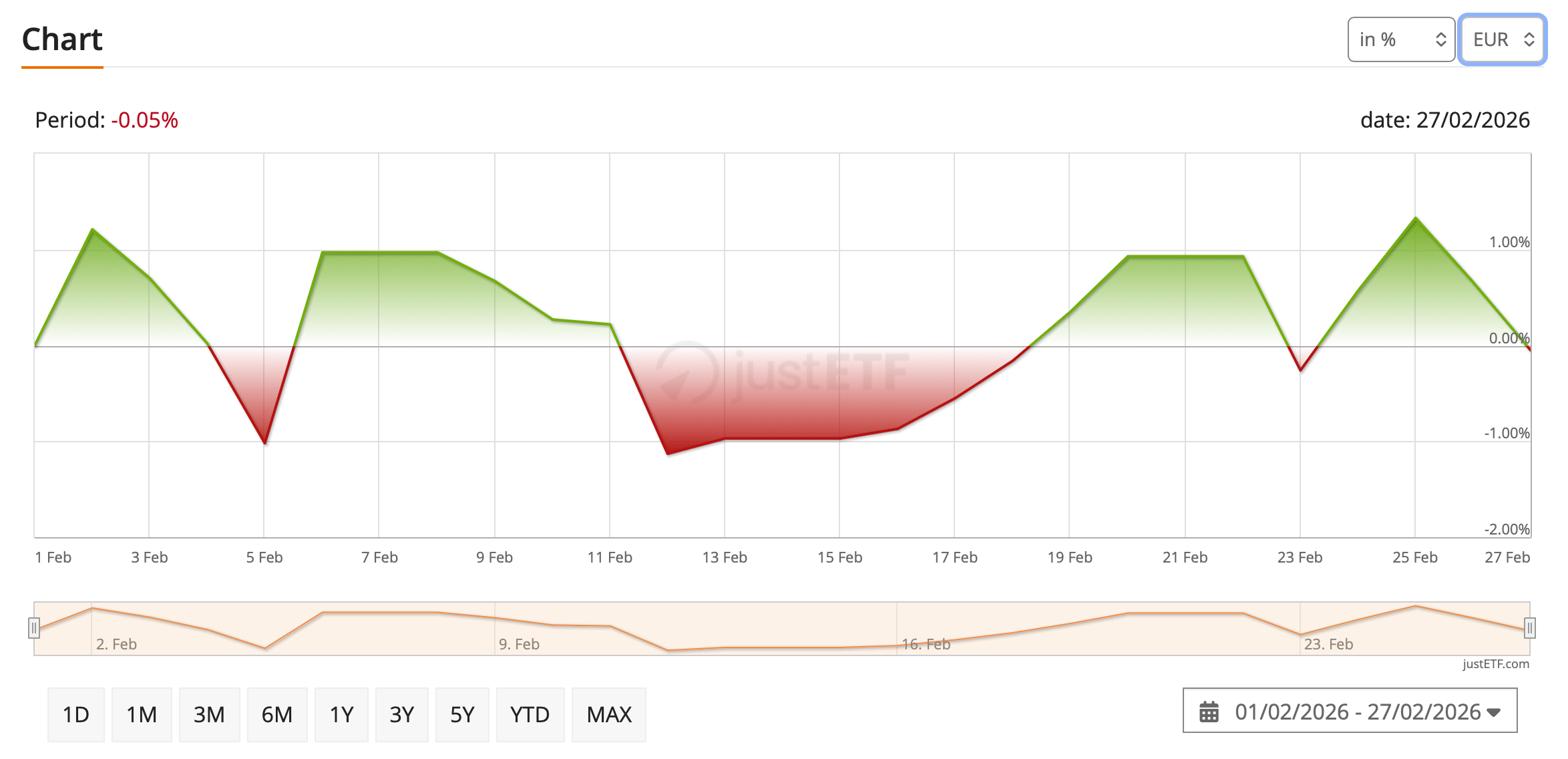
iShares Core S&P 500 UCITS ETF (Accumulating)
JustETF
In Euros, the iShares S&P 500 UCITS ETF (Acc) finished the month flat. Again, this is slightly better than the US dollar performance for February.
Vanguard EUR Corporate Bond ETF (Accumulating)

JustETF
Another good month for the Vanguard EUR corporate Bond ETF (Acc) with a positive return of 0.56%.
Bitcoin Monthly Performance $BTC ( ▲ 0.9% )

Coinglass
Yet another disappointing month for Bitcoin, which has now entered bear market territory. Bitcoin investors have to be prepared for deep drawdowns like this. This is the fifth negative month in a row, so let’s see if there is a reversal in March or April.

Can Bulls Live with Bears?

The Animal Language of Financial Markets
Can bulls live with bears?
When you read the financial news, you will often find comments about current market sentiment: "we are in a bull market" or "we are in a bear market." But the reality is more complex, because the market is made up of many different asset classes, and they do not always move in the same direction.
So, can we apply just one label to the entire market at any given time? Before we answer that, let's look at the definitions.
What is a Bull Market?
A bull market is usually defined as a rise of 20% or more from a recent low.
The name comes from the way a bull attacks, driving its horns upward. This upward movement made the bull a natural symbol of rising markets and financial optimism. You may remember the famous Charging Bull sculpture on Wall Street, which we discussed in an earlier newsletter.
What is a Bear Market?
A bear market is usually defined as a fall of 20% or more from a recent high.
The origin of 'bear' is more interesting than most people realise. In 18th century London, traders known as 'bearskin jobbers' would sell bearskins before they actually owned them, betting that prices would fall so they could buy cheaply and profit. The downward swipe of a bear's paw later reinforced the image perfectly.
The Cryptocurrency Volatility Problem
You may have noticed that I used the word 'usually' in both definitions above. For a financial definition, this is unusual.
The reason is that cryptocurrencies have created a problem for market commentators. The extremely high volatility of assets like Bitcoin means that a 20% move can happen in a matter of days, or even hours. If we applied the standard definition strictly, Bitcoin could technically flip between bull and bear markets several times a year.
For this reason, crypto markets are generally considered bearish only after a fall of 50% or more from a recent high.
Can Bull Markets and Bear Markets Coexist?
At the moment, the S&P 500 is trading in the region of 7,000, close to all-time highs. The last major low was approximately 4,800 in April 2025, following President Trump's tariff announcements. A rise of around 46% from that low easily puts us firmly in bull market territory.
On the other hand, Bitcoin recently traded briefly around $60,000, having reached an all-time high of approximately $126,000 in October 2025. A decline of over 50% from that peak places it, in my view, firmly in bear market territory.
So, we currently have a bull market in equities and a bear market in Bitcoin, nicely proving that bulls and bears can coexist. This is because the market is made up of diverse asset classes that move independently.
How to Handle Market Sentiment
No matter what the labels are, your own psychology is much more important in making you a successful investor.
I have lived through many bull and bear markets in my investing life. The most important question I ask myself is whether anything has fundamentally changed to prevent markets from reaching all-time highs again. When it comes to indexes, all-time highs have always eventually returned. Equities are at or near all-time highs, and Bitcoin was there as recently as October 2025. I should note that individual equities, as opposed to indexes, can fall and never recover, so more research is needed when fundamentals change.
My attitude is always to look for buying opportunities in bear markets.
Note: These terms, particularly when applied to cryptocurrencies, are somewhat subjective. At the moment, some market commentators will say we are in a Bitcoin bear market, whilst others may disagree. As always with financial language, context and perspective matter.
As always, none of this is financial advice. Everyone should invest according to their personal circumstances, risk tolerance and financial goals.

Quote of the Day: Michael Saylor
"Bitcoin's volatility is a feature, not a bug."
The volatility of Bitcoin, with many drops of 50% or more, has allowed new investors to enter the market at a better price.
Language note: In this context, 'bug' means a fault or defect in a system.
"My software program has a bug and crashes frequently."
Saylor is arguing that Bitcoin's volatility is not a fault and is in fact a good thing.

We Value Your Feedback!
Your opinion helps us improve and lets you suggest topics or ask Business English questions for future issues.
How did you find this week’s newsletter? |
Word of the Day: Sentiment
Sentiment - noun - the general feeling, attitude, or mood of investors towards a particular market, asset, or the economy as a whole; the emotional tone that drives buying and selling decisions.
"When you read the financial news, you will often find comments about current market sentiment."
Context and Usage: Sentiment is a key concept in financial markets because investor psychology often drives prices as much as underlying fundamentals. Positive sentiment leads to buying, which pushes prices higher. Negative sentiment leads to selling, which pushes prices lower. Understanding sentiment helps investors recognise when markets may be driven by emotion rather than logic.
Note: Sentiment is not limited to finance. It is widely used in business, politics, and everyday English to describe the general mood or feeling towards any topic.
"Public sentiment towards the new policy was largely negative."
Common Collocations:
Market sentiment - the overall mood of investors towards financial markets Market sentiment turned negative after the interest rate announcement, triggering a sharp sell-off.
Investor sentiment - the attitude of investors towards a particular asset or market Investor sentiment towards Bitcoin has reached extreme fear levels, with the Fear and Greed Index hitting single figures.
Bullish sentiment - optimistic outlook among investors Bullish sentiment returned to equity markets after stronger than expected earnings results.
Bearish sentiment - pessimistic outlook among investors Bearish sentiment dominated cryptocurrency markets throughout the first quarter.
Gauge sentiment - to measure or assess the mood of the market Analysts use surveys and trading data to gauge sentiment before making investment recommendations.
Business Example: The CEO delayed the product launch after internal surveys revealed negative consumer sentiment towards the new pricing strategy.
Everyday Context: Outside of finance, sentiment appears frequently in business and professional English. "Employee sentiment surveys showed that staff morale had improved significantly following the restructuring." Understanding sentiment, both in markets and in organisations, is an essential skill for anyone working in an international business environment.
Interactive Quiz
How do you feel in a bear market? |
Did you think bull markets and bear markets could occur together? |
Whenever you are ready, here is how I can help you:
We provide Business English lessons and Cambridge and IELTS preparation courses.
You can book a free 20-minute consultation with Iain over Zoom here:
Why not subscribe to our sister Business Fluency newsletter? It helps English students master essential business terms and provides practical strategies to boost your career prospects.


Disclaimer:
This newsletter is for informational and educational purposes only and should not be construed as financial advice. The information contained herein is generic and does not take into account your individual financial circumstances. You should always consult with a qualified financial professional before making any investment or financial decisions.
Additionally, the authors and/or publishers of this newsletter may hold investments in securities or other financial instruments mentioned herein. These are included for illustrative purposes only and should not be taken as a recommendation to buy or sell such securities or financial instruments.