- Financial Fluency
- Posts
- Fighting Bears

In partnership with

If you work in fintech or finance, you already have too many tabs open and not enough time.
Fintech Takes is the free newsletter senior leaders actually read. Each week, I break down the trends, deals, and regulatory moves shaping the industry — and explain why they matter — in plain English.
No filler, no PR spin, and no “insights” you already saw on LinkedIn eight times this week. Just clear analysis and the occasional bad joke to make it go down easier.
Get context you can actually use. Subscribe free and see what’s coming before everyone else.
Welcome to Financial Fluency - your monthly guide to mastering financial English, learning how money works, and making confident financial choices.
In this issue:
A Look at the Markets: Performance March 2026
Fighting Bears
Quote of the Day: Charlie Munger
We value your feedback
Word of the Day: Safe Haven
Interactive Quiz
Whenever you are ready, here is how I can help you

A Look at the Markets: Performance March 2026
Vanguard FTSE All-World ETF (Accumulating)

JustETF.com
In last month's newsletter, I noted that the US airstrikes in Iran began on 28th February, after markets had already closed for the month. March’s performance can therefore be attributed to the conflict. The Vanguard FTSE All-World ETF (Acc) fell 4.83% in Euros, as geopolitical uncertainty weighed heavily on global equity markets.
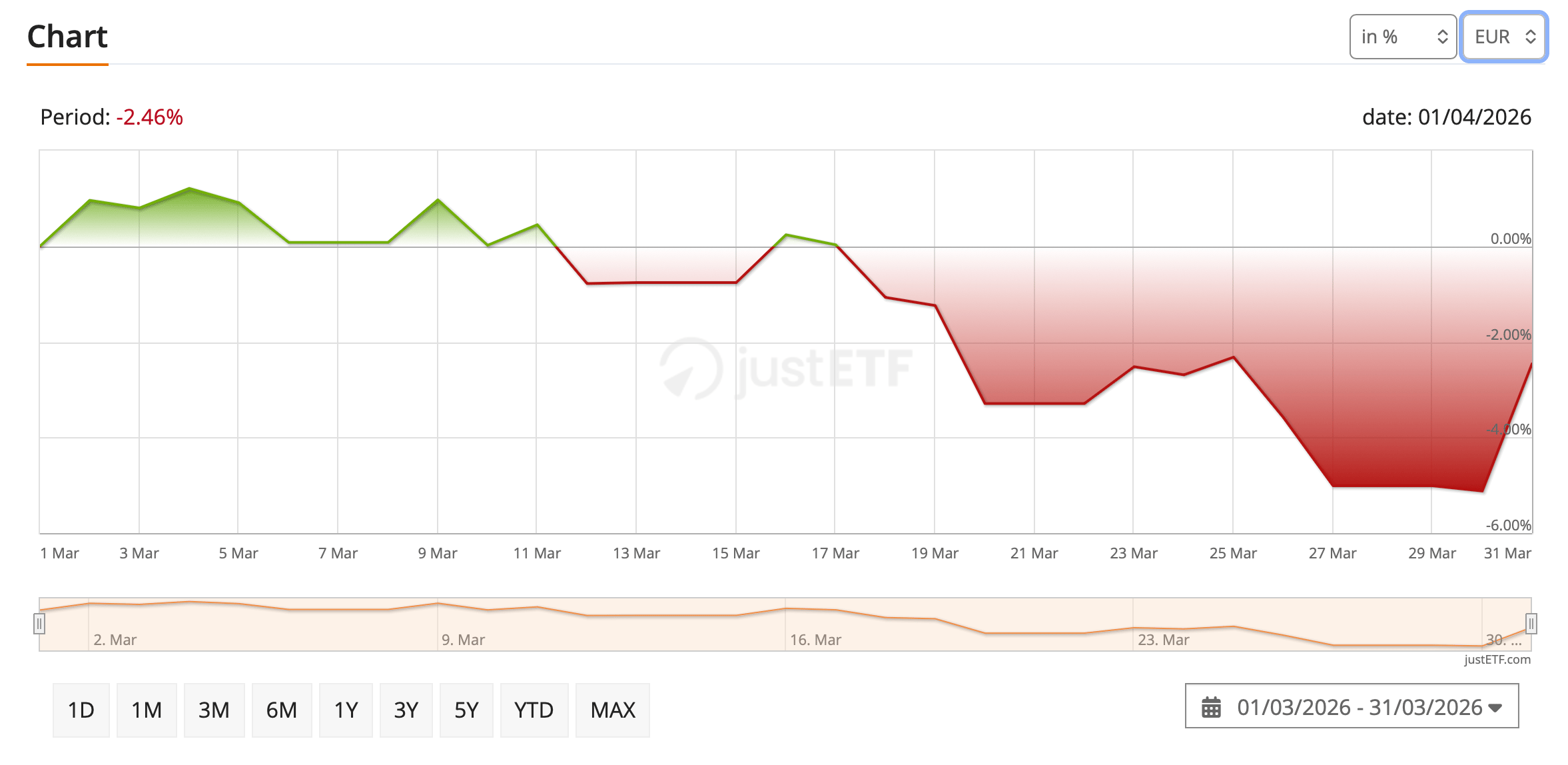
iShares Core S&P 500 UCITS ETF (Accumulating)
JustETF.com
Geographically, Iran is considerably closer to Europe than the United States, and Europe is more susceptible to increases in energy prices. It is perhaps no surprise, therefore, that the S&P 500 held up better than global markets in March. The iShares Core S&P 500 UCITS ETF (Acc) still finished the month down 2.46% in Euros.
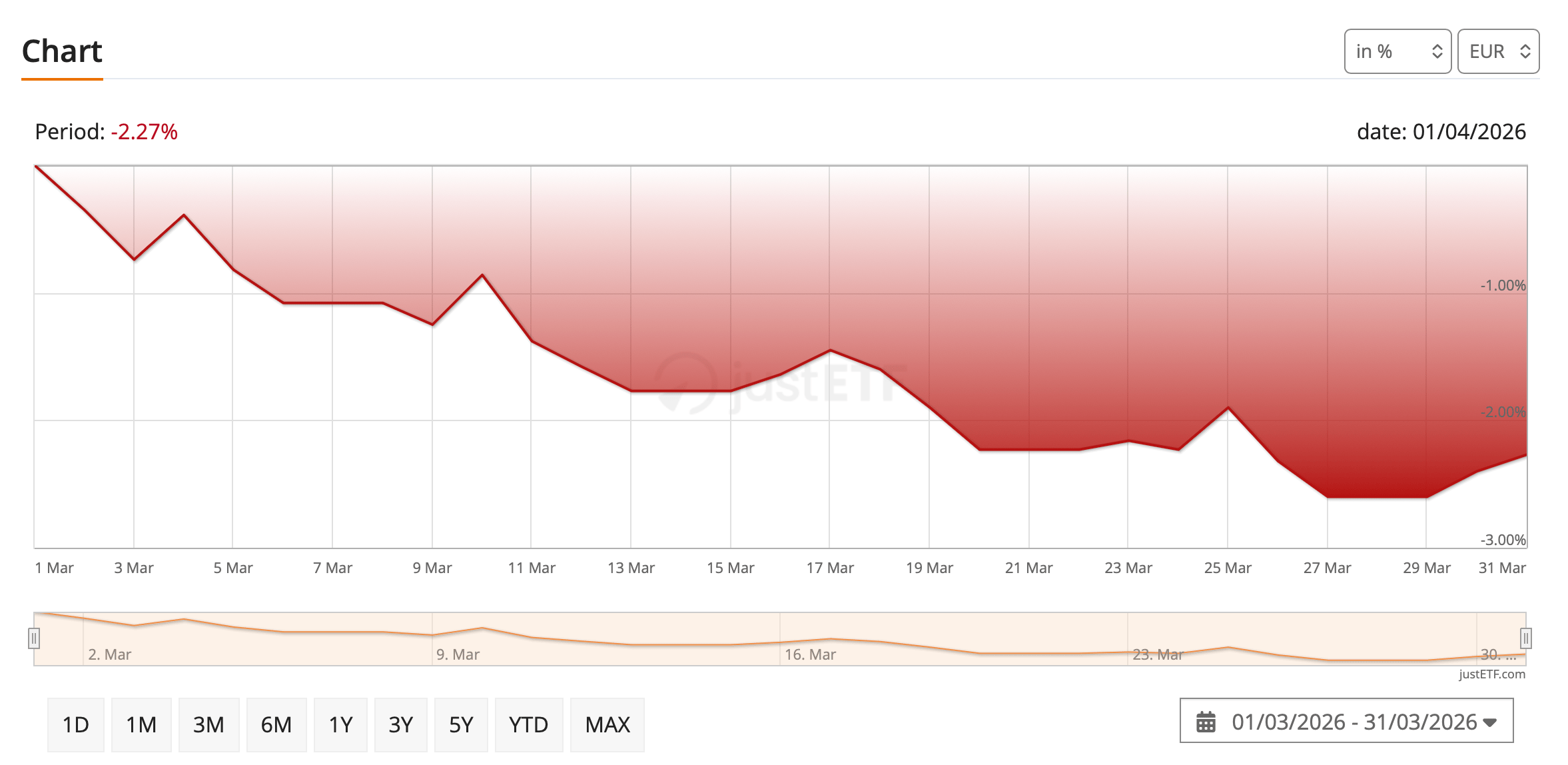
Vanguard EUR Corporate Bond ETF (Accumulating)
JustETF.com
I hold European corporate bonds specifically to reduce volatility in my overall portfolio. The trade-off is straightforward: less upside when markets rise, but less downside when they fall. Compared to the Vanguard FTSE All-World ETF's 4.83% drop, the Vanguard EUR Corporate Bond ETF (Acc) finishing March down 2.27% neatly illustrates that point.
Bitcoin Monthly Performance $BTC ( ▼ 1.35% )
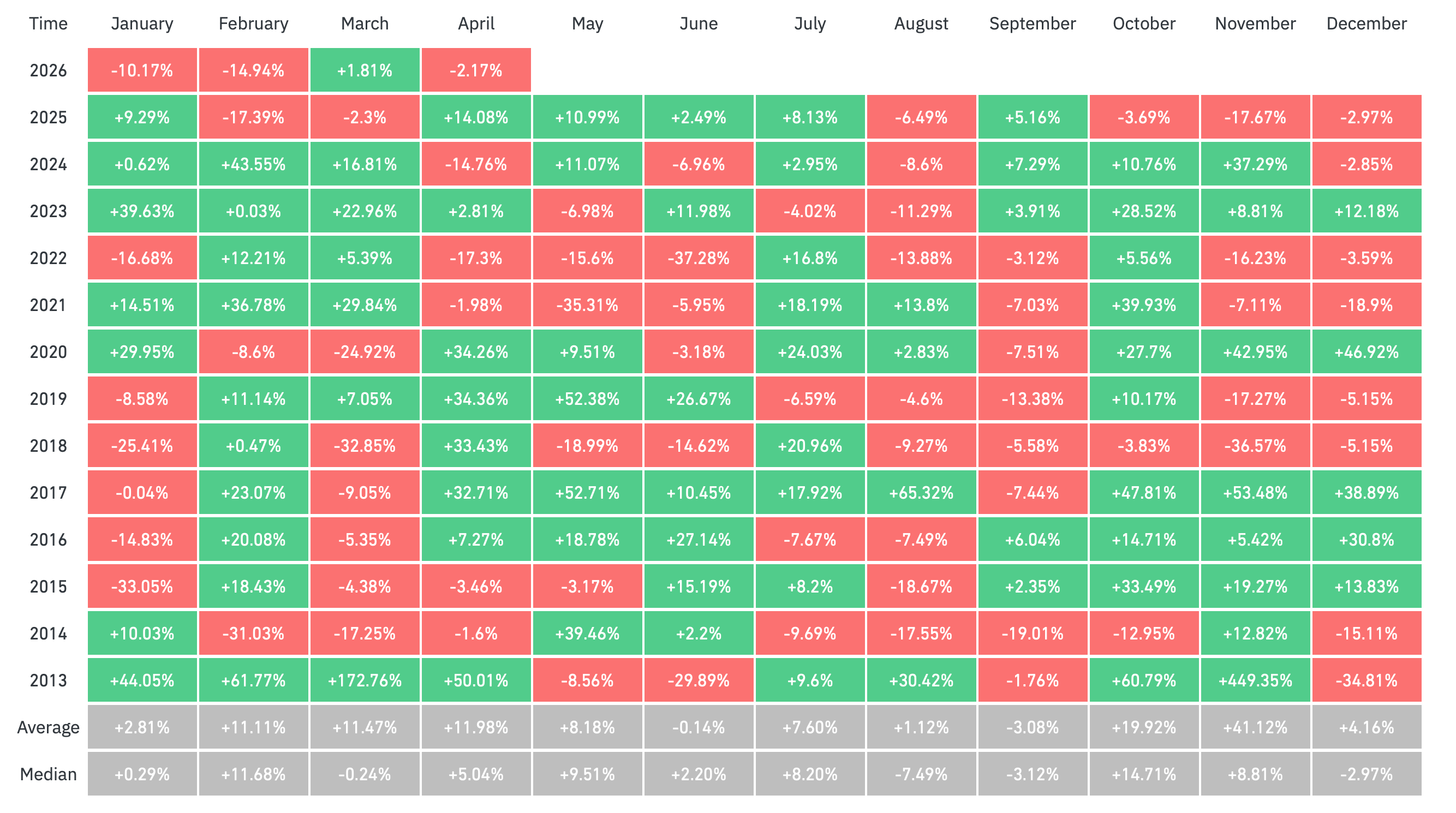
After five consecutive negative months, Bitcoin reversed its losing streak in March with a gain of 1.81% in US dollars. Due to the strengthening of the dollar against the Euro, this translated to approximately 3.6% for European investors.
You will still hear financial commentators arguing that Bitcoin is not a safe haven asset. They may have a point, and I am certainly not arguing otherwise. However, it is worth noting that in March, Bitcoin significantly outperformed gold, which is widely considered one of the ultimate safe haven assets. Gold fell 11.3% in Euros during the month — its worst performance in over a decade. Whatever label you give Bitcoin, on this occasion at least, it held up considerably better than the asset most associated with safety.

Fighting Bears

What should an investor do in uncertain times?
A business student asked me this week what I was doing with my investments. Given that US airstrikes in Iran had triggered increased geopolitical instability and sent global markets lower, he was probably expecting a considered answer about repositioning my portfolio or moving into safer assets.
Nothing.
But was this the correct decision?
Could Investors Have Seen This Coming?
I am sure that many investors felt that the airstrikes were inevitable after the visible buildup of US military assets in the Gulf.
While there is a compelling argument for this, President Trump has proved to be far more unpredictable than most political leaders. To make important portfolio decisions based on this, investors would have had to have been one hundred per cent sure that airstrikes were coming. It is also worth noting that I am making an important distinction here between long-term investors like me and short-term traders and hedge fund managers who have to control risk, overall drawdown, and asset allocation much more closely.
For long-term investors, in my view, that level of certainty is rarely possible.
Even If You Knew, What Would You Have Done?
Let's just assume that you had a crystal ball and were certain that airstrikes were coming, what would you have done?
The obvious answer would have been to sell your risk-on assets, such as the Vanguard FTSE All-World ETF and the S&P 500, and move into safe-haven or risk-off assets. Risk-on assets are those bought when investors want to take more risk, while risk-off assets are bought when investors want to reduce it. Bitcoin is still widely considered a risk-on asset, so few investors would have been inclined to buy it in this situation.
The obvious risk-off asset is gold.
The Safe Haven That Wasn't
In last month's newsletter, we defined a bear market as a drop of 20% or more from recent highs.
The chart above shows that gold fell nearly 27% from its all-time high in January 2026, measured in US dollars, with much of this loss occurring in March. Although it has since partially recovered, it remains nearly 18% below its peak. For context, March was gold's worst monthly performance in over a decade.
Despite its reputation as the ultimate safe haven or risk-off asset, gold is the only one of the assets I regularly track that has entered a technical bear market.
Why Did Gold Fall?
To put gold's March performance in context, we should remember that gold has been one of the best performing assets of recent years.
Gold rose from just over $1,600 in late 2022 to around $5,600 in January 2026, a remarkable bull run of nearly 250% in just over three years. It is therefore reasonable to assume that many investors were looking for a reason to take profits, and the uncertainty created by the Middle East conflict provided exactly that. Additionally, rising oil prices tend to strengthen the US dollar, which puts downward pressure on gold since it is priced in dollars. Rising oil prices also raise inflation expectations, which in turn suggests interest rates may rise, and since gold pays no interest or dividend, it becomes a less attractive asset when rates are high.
This newsletter is not a thesis against gold. Investors who bought during the bull run have still enjoyed extraordinary returns.
The Real Reason for my Inactivity
Selling assets is a taxable event.
It is all very well trying to time the market, but investors should remember that selling assets with good returns triggers a capital gains tax liability, which immediately reduces the value of your portfolio. At least if I hold assets that have fallen in value, I still own them if and when the market recovers. Markets, as we have discussed many times in this newsletter, always recover over the long term.
I should note that, at the time of writing, the conflict in the Middle East has not been resolved, and we will never fully know whether my decision was correct until it has been.
As always, none of this is financial advice. Everyone should invest according to their personal circumstances, risk tolerance and financial goals.

Quote of the Day: Charlie Munger
"The first rule of compounding: Never interrupt it unnecessarily."
The above quote sums up what I am talking about when thinking about investments over the long term. Selling and trying to rebuy at the best opportunity (timing the market) would have been interrupting long-term compounding. Charlie Munger was Warren Buffett’s business partner.

We Value Your Feedback!
Your opinion helps us improve and lets you suggest topics or ask Business English questions for future issues.
How did you find this week’s newsletter? |
Word of the Day: Safe Haven
Safe Haven - noun phrase - an asset, currency, or investment that is expected to retain or increase its value during periods of market turbulence, geopolitical uncertainty, or economic crisis.
"Despite its reputation as the ultimate safe haven, gold is the only one of the assets I regularly track that has entered a technical bear market."
Context and Usage: In financial markets, safe haven assets are those that investors turn to when they want to reduce risk. The term implies stability and protection — somewhere to "hide" your money when conditions are difficult. However, as this newsletter demonstrates, safe haven status is not guaranteed, and even traditional safe havens can underperform during certain types of crisis.
Note: "Safe haven" is also used outside of finance to describe a place of refuge or protection. Understanding both uses is useful for B2+ learners working in international business contexts.
Note on "Haven": A haven is a place of safety or refuge. The word comes from the Old English word for harbour — a safe place for ships to shelter from storms. In everyday English you might hear "a haven of peace" or "tax haven." Combined with "safe," it creates a powerful image of protection from financial storms.
Common Collocations:
Safe haven asset - an investment considered reliable during turbulent times Gold has traditionally been considered the ultimate safe haven asset, though its performance in March 2026 challenged that assumption.
Safe haven currency - a currency that holds its value during uncertainty The US dollar and Swiss franc are widely considered safe haven currencies during periods of global instability.
Traditional safe haven - an asset with a long history of stability during crises Government bonds are considered a traditional safe haven, alongside gold and certain currencies.
Business Example: During the financial crisis, the company moved its cash reserves into safe haven assets to protect against currency volatility and market uncertainty.
Everyday Context: Outside of finance, "safe haven" appears frequently in news and political contexts. "The country offered safe haven to refugees fleeing the conflict." Understanding this broader usage helps learners recognise the term across different reading and listening contexts.
Interactive Quiz
How do you feel when the markets are uncertain? |
Have you ever tried to time the market? |
Whenever you are ready, here is how I can help you:
We provide Business English lessons and Cambridge and IELTS preparation courses.
You can book a free 20-minute consultation with Iain over Zoom here:
Why not subscribe to our sister Business Fluency newsletter? It helps English students master essential business terms and provides practical strategies to boost your career prospects.


Disclaimer:
This newsletter is for informational and educational purposes only and should not be construed as financial advice. The information contained herein is generic and does not take into account your individual financial circumstances. You should always consult with a qualified financial professional before making any investment or financial decisions.
Additionally, the authors and/or publishers of this newsletter may hold investments in securities or other financial instruments mentioned herein. These are included for illustrative purposes only and should not be taken as a recommendation to buy or sell such securities or financial instruments.